
Ninety minutes before kickoff, a stadium hospitality lounge faces a problem most restaurants never will: feeding and seating a surge of guests who all arrive at once, eat fast, and clear out the moment the whistle blows. Then it does the whole thing again at halftime. The operation that handles that rhythm without a hitch is built on furniture chosen for one job, turning crowds fast.
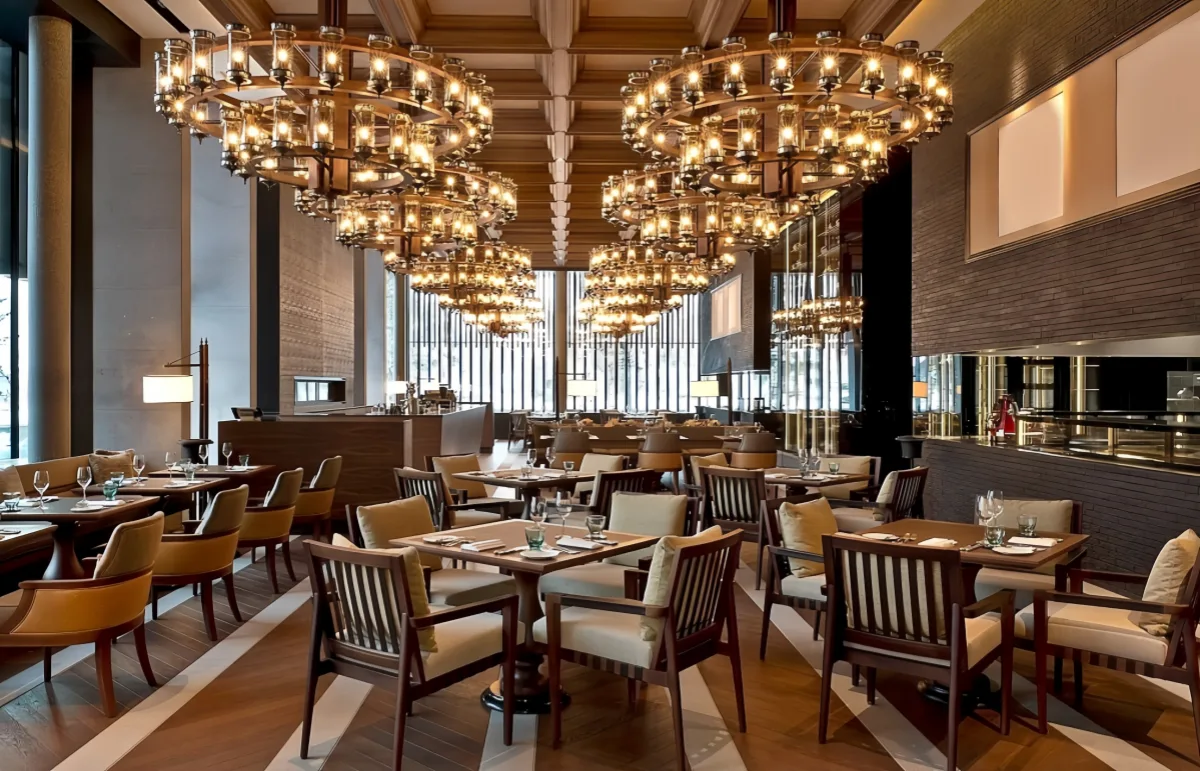
Step behind the concourse glass into a club lounge or a stadium-adjacent pub on matchday and the design logic becomes obvious. There is no time for fragile, no patience for mismatched, no room for a layout that slows the line. The whole zone is engineered around durable, uniform restaurant table and chair sets that can take a beating, reset in seconds, and look sharp for the broadcast cameras and the season-ticket regulars alike.
The Surge Defines Everything
Matchday traffic does not flow. It spikes. A lounge that sits quiet for hours fills to capacity in a twenty-minute window, churns through service, then empties and refills at the break. That pattern punishes furniture in a way a steady dinner service never does.
The seating has to survive thousands of sit-downs and stand-ups per event, the scrape of chairs across hard floors, and the occasional celebratory bang on the table. Demand studies in commercial spaces put durability at the top of the list for a reason: a large share of operators cite it as the deciding purchase factor. In a stadium, that priority is not a preference. It is the only way the room makes it through a season.
Matched Sets Move the Line
Why do these zones favor identical table-and-chair sets rather than a curated mix? Speed. When every chair is the same height and every table the same footprint, staff can reset a section in seconds, stack and clear without puzzle-solving, and reconfigure a room from dining rows to standing reception between events.
Uniformity also reads as professional on camera and to a premium guest paying for the experience. A matched set signals an operation that has its act together, while a patchwork of leftovers signals the opposite, a contrast any premium venue wants to avoid. The consistency is both operational and visual, which is exactly what a high-stakes hospitality area needs.
Turning the Table Is the Whole Game
In matchday hospitality, an empty seat is lost revenue, and a seat that is hard to clear is a bottleneck. The math of return on investment in these spaces runs on turnover: how many guests a given square footage can serve across the pre-match, halftime, and post-match windows.
Furniture either helps or hurts that number. Tables sized to the space, chairs light enough to move but solid enough to last, and a layout with aisles wide enough for a server carrying a full tray all speed the cycle. A few inches of extra clearance, generally a couple of feet of room per diner, keeps the flow moving when a hundred people want their food in the same ten minutes.
What Operations Teams Actually Specify
Outfitting a matchday zone is as much a procurement exercise as a design one. The teams that get it right tend to lock in on the same hard requirements:
- Frames rated for high-traffic commercial cycles, not light hospitality use.
- Surfaces that wipe clean fast between sittings and resist spills and stains.
- Stackable or easily movable chairs for quick resets and event reconfiguration.
- Uniform dimensions across the set so any chair pairs with any table.
- Finishes that hold up under stadium lighting and the broadcast eye.
Each spec ties back to the same pressure: a lot of people, very little time, repeated throughout an entire fixture schedule.
The Furniture Behind the Roar
Fans remember the goal, the chant, the pint raised at the final whistle. They never think about the chair that held them or the table that took their plate. That invisibility is the point. Hospitality furniture in these rooms succeeds by disappearing into a smooth, fast, repeatable experience that lets the day feel effortless.
For the operators behind the glass, though, the furniture is anything but an afterthought. It is the infrastructure that decides whether the room serves four hundred guests cleanly or chokes on its own crowd. Matched, durable table and chair sets are the unglamorous backbone of every great matchday, doing their work in the margins while the noise builds out on the pitch.
