
Immunity testing evaluates how electrical and electronic equipment continues to operate correctly when subjected to defined electromagnetic and power quality disturbances. Unlike emission testing, which focuses on what a device injects into its environment, immunity testing focuses on how the device behaves when the environment itself is disturbed.
For grid-connected and power-electronic-based equipment—such as inverters, chargers, motor drives, and energy storage systems—many immunity phenomena are conducted through the AC power port. As a result, programmable AC power supplies and grid simulators have become central instruments for executing immunity tests defined in international standards issued by organizations such as International Electrotechnical Commission and IEEE. A company specialized in IEEE and IEC standards testing application should support your pre-certification testing for your grid-connected products before they launch into market.
Overview of Key Immunity Standards Involving AC Power Disturbances
Several immunity standards directly rely on controlled manipulation of supply voltage, frequency, and waveform characteristics:
- IEC 61000-4-11: Voltage dips, short interruptions, and voltage variations for equipment ≤16 A per phase
- IEC 61000-4-34: Voltage dips and interruptions for equipment with higher current ratings
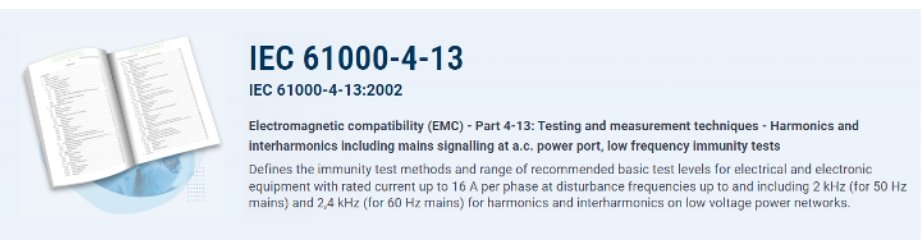
- IEC 61000-4-13: Harmonic and interharmonic voltage disturbances
- IEC 61000-4-14 / -4-28: Voltage fluctuations and frequency variations

A common feature across these standards is that immunity performance is evaluated not only by whether the equipment survives the disturbance, but also by functional criteria (performance criteria A, B, C) that require precise control and repeatability of the applied disturbance. This requirement places strict demands on the power source used for testing.
Role of Programmable AC Power Supplies in Immunity Testing
Programmable AC power supplies serve as controlled disturbance generators, capable of synthesizing non-ideal grid conditions with defined magnitude, duration, and phase relationships.
From a testing perspective, their core contributions include:
- Precise voltage and frequency control, enabling compliance with tolerance bands defined in IEC standards
- Fast transition capability, required for generating abrupt dips, interruptions, and step changes
- Repeatable waveform synthesis, essential for comparing results across multiple test runs or EUT revisions
For lower-power or unidirectional test scenarios, programmable AC sources are often sufficient to execute immunity tests where the EUT does not return significant energy to the source.
Grid Simulators for Advanced and Bidirectional Immunity Scenarios
As power-electronic EUTs increasingly exhibit bidirectional energy flow, conventional AC sources can become a limitation. During voltage dips, phase jumps, or recovery events, devices such as inverters and regenerative drives may feed energy back toward the source.
Grid simulators extend the role of programmable AC supplies by adding:
- Four-quadrant operation, allowing both sourcing and sinking of active power
- Regenerative capability, safely returning absorbed energy to the grid
- Stable operation under dynamic EUT interaction, especially during recovery from disturbances
These capabilities are particularly relevant for immunity testing of DER-related equipment, where realistic grid behavior must be maintained even when the EUT actively responds to the disturbance.
Interpreting Standards Through a Test Power Source Perspective
Many immunity standards implicitly assume an idealized grid source—one that can impose disturbances while maintaining defined RMS voltage, frequency, and phase relationships.
For example, IEC 61000-4-13 specifies that harmonic and interharmonic components are superimposed on the fundamental voltage while the resultant RMS voltage remains constant. Achieving this in practice requires a power source with sufficient bandwidth, control resolution, and closed-loop regulation.
Programmable AC power supplies and grid simulators effectively act as standard translators, converting written test definitions into executable electrical waveforms that meet both numerical limits and temporal constraints.
Enabling Automated Immunity Testing
Automation is increasingly critical in immunity testing due to the growing number of test conditions and performance criteria.
Programmable AC sources and grid simulators support automation by offering:
- Remote control interfaces (LAN, SCPI, Python/IVI drivers) for integration into test frameworks
- Scriptable disturbance profiles, enabling automated sequencing of dips, swells, frequency changes, and harmonic injection
- Synchronized triggering and timing control, ensuring deterministic application of disturbances relative to EUT operating states
When combined with automated measurement systems and pass/fail logic, the power source becomes a central node in a closed-loop immunity validation platform rather than a standalone instrument.

Practical Benefits in Engineering and Compliance Workflows
From an engineering workflow perspective, the use of programmable AC power supplies and grid simulators allows immunity testing to move upstream—from late-stage certification into development and pre-compliance phases.
This shift enables:
- Early identification of control instability or protection miscoordination
- Faster iteration on firmware and control algorithms
- Reduced risk of non-compliance during formal certification testing
By reusing the same programmable power infrastructure across R&D, validation, and compliance testing, organizations gain both technical consistency and operational efficiency.
Conclusion
Immunity testing is no longer a purely compliance-driven activity; it has become an integral part of validating how modern power-electronic systems interact with a disturbed grid environment. Programmable AC power supplies and grid simulators provide the electrical fidelity, control precision, and automation capability required to translate immunity standards into repeatable, executable test scenarios.
As grid conditions become more complex and EUT behavior more dynamic, these instruments increasingly function not just as test equipment, but as active grid emulation platforms that enable scalable, automated, and standards-aligned immunity testing across the product lifecycle.
